
Cotton, The Motorcycle Masterpiece ®
Sports Models for 1929
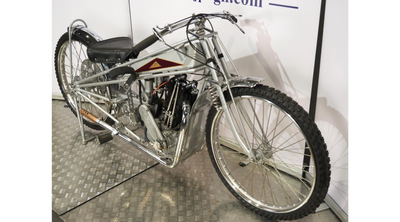
Cotton-Blackburne Speedway motorcycle (1929)
In 1929, Cotton produced a number of specialist Speedway motorcycles, built individually at the Gloucester factory to meet the precise requirements of competition riders. Unlike standard road models, these machines were not officially listed in the Cotton catalogue, as each example was custom-built to order.
One surviving example is believed to have been raced by J.H. Law, and remarkably retains its original rider entry postcards, adding rare documentary provenance to the machine.
Frame: Cotton (England), triangulated racing specification
Engine: Blackburne 500cc single-cylinder, twin-port
Power Output: Approx. 28 bhp @ 5,300 rpm
Engine Number: GBB633
Clutch: Burman multi-plate
Carburettor: Amac twin-float
Fuel: RDI or PMS racing fuel
Engineering Significance
The 500cc twin-port Blackburne engine was a formidable unit for its time. Producing approximately 28 brake horsepower, it offered strong acceleration and high rotational capability — critical attributes in the short, intense environment of speedway racing. The twin-port cylinder head improved breathing efficiency, allowing better combustion and enhanced throttle response.
Cotton’s patented triangulated frame provided exceptional rigidity, particularly important in speedway competition where rapid directional changes placed high stress on the chassis.
Competition Context
During the late 1920s, speedway racing was gaining rapid popularity in Britain. Cotton’s decision to produce bespoke racing machines demonstrated the company’s willingness to support competitive riders directly.
Although these machines were not formally catalogued, a significant number were built and used in competition. Each was effectively a factory special, tailored to the purchaser’s requirements — gearing, carburation, and tuning varying according to rider preference.
Historical Importance
The 1929 Cotton–Blackburne Speedway represents:
- Cotton’s deep engagement with competitive motorcycling
- The flexibility of the triangulated frame in specialist racing use
- The partnership between Cotton chassis engineering and Blackburne engine performance
- A rare example of pre-war British speedway engineering
The survival of original rider entry documentation further elevates this machine from competition tool to historical artefact.

Cotton, The Motorcycle Masterpiece ®
Sports Models for 1928
The Cotton motorcycles introduced for 1928 represented a significant advance over the previous year’s machines.
Several attractive sports models were offered, powered by J.A.P. or Blackburne overhead-valve engines, available in single-port or twin-port versions. These models were fitted with handsome saddle tanks, enhancing both appearance and practicality.
The frame was shortened and built using heavier tubing, increasing strength. Special attention was given to the magneto mounting, which was placed high behind the engine in a position that was easy to access.
Overall, the 1928 Cotton was described as a machine that would immediately appeal to sporting riders, especially those familiar with the excellent road-holding qualities of the Cotton triangulated frame.

1929 Cotton 350cc JAP
The 1929 Cotton 350cc JAP was a high-quality British sporting motorcycle, combining a proven performance engine with Cotton’s advanced chassis design.
The machine was powered by a 350 cc J.A.P. single-cylinder engine, a unit widely respected for its reliability, strong power output, and suitability for both fast road riding and competition. JAP engines were among the most successful of the period, and their use reflected Cotton’s focus on performance and quality.
Central to the motorcycle was the Cotton fully triangulated frame, a hallmark of the marque. By the end of the 1920s, this frame design had been further refined, offering exceptional rigidity with controlled weight, resulting in excellent road holding and precise steering. Compared with conventional frames, the Cotton chassis provided superior stability, especially at speed.
The engine was mounted inclined forward, lowering the centre of gravity and improving balance through corners. Power was transmitted through a three-speed gearbox with clutch and all-chain final drive, reinforcing the sporting character of the machine.
With its purposeful proportions, clean mechanical layout, and strong performance credentials, the 1929 Cotton 350cc JAP appealed to riders who valued confident handling and engineering integrity. Today, it is regarded as a fine example of late inter-war British sporting motorcycle design, and a clear continuation of Cotton’s reputation for building machines where handling was as important as speed.
1928 Cotton JAP 500cc
The 1928 Cotton JAP 500cc was a powerful British sports motorcycle, built for riders who wanted serious performance combined with advanced chassis design.
It was powered by a 500 cc J.A.P. overhead-valve single-cylinder engine, an engine famous for its strength, reliability, and high performance in racing and sporting use. JAP engines were widely respected at the time, and in 500 cc form they delivered strong torque and impressive top speed.
As with all Cotton motorcycles, the defining feature was the fully triangulated Cotton frame.
Constructed to be both rigid and lightweight, it provided excellent road holding and precise handling, clearly superior to conventional diamond frames of the period. For 1928, the frame was shortened and built from heavier tubing, further improving strength and stability.
The engine was mounted inclined forward, which lowered the centre of gravity and improved balance, especially when cornering at speed. Power was transmitted through a three-speed gearbox with clutch and all-chain final drive, reflecting Cotton’s focus on sporting performance.
The 1928 sports models were also distinguished by attractive saddle tanks, clean mechanical layout, and a carefully positioned magneto mounted high behind the engine for easy access. Every detail was aimed at riders who valued performance, handling, and engineering quality.
The Cotton JAP 500cc of 1928 is remembered today as a true inter-war sports machine — fast, purposeful, and technically advanced — and a strong expression of the Cotton philosophy: exceptional road holding through intelligent frame design.
Cotton Sport Lusso Sidevalve (1928)
The Cotton Sport Lusso Sidevalve (1928) was a refined sporting motorcycle designed to combine performance, comfort, and elegant finish, reflecting a more luxurious interpretation of the Cotton philosophy.
Powered by a side-valve single-cylinder engine, the Sport Lusso offered smooth, reliable performance well suited to fast road use and longer-distance riding. While less extreme than the overhead-valve sports models, the side-valve engine was valued for its durability, quiet running, and ease of maintenance.
As with all Cotton machines of the period, the Sport Lusso was built around the fully triangulated Cotton frame. By 1928 this frame had been shortened and constructed from heavier-gauge tubing, giving excellent rigidity and stability while retaining relatively low weight. The result was confident handling and outstanding road holding, even on poor road surfaces.
The engine was mounted inclined forward, lowering the centre of gravity and improving balance. Power was delivered through a three-speed gearbox with clutch and chain final drive, providing smooth and dependable transmission.
The “Lusso” character was expressed through careful attention to detail: a well-shaped saddle tank, clean mechanical layout, quality fittings, and a riding position that balanced sporting intent with comfort. These features made the model particularly attractive to riders seeking a machine that was both capable and refined.
Cotton 1928 Super Sport OHV
The Cotton Super Sport OHV of 1928 represented the most performance-focused expression of the Cotton range in the late 1920s. It was designed for riders who demanded speed, precision handling, and advanced engineering rather than everyday practicality.
At the heart of the Super Sport was an overhead-valve single-cylinder sports engine, selected for its ability to run at high revolutions and deliver strong top-end performance. This made the model capable of impressive speeds for its class and well suited to fast road riding and competition use.
The motorcycle was built around the famous Cotton fully triangulated frame, a design that had already proven itself in racing and trials. For 1928, the frame was shortened and constructed from heavier-gauge tubing, increasing rigidity while preserving lightness. This gave the Super Sport exceptional road holding and stability, especially when cornering at speed.
The engine was mounted inclined forward, lowering the centre of gravity and improving balance. Power was transmitted through a three-speed gearbox with clutch and all-chain final drive, reflecting the machine’s sporting intent.
Visually, the Super Sport was distinguished by its attractive saddle tank, clean mechanical layout, and carefully considered details such as the high, easily accessible magneto mounting behind the engine. Every element was designed to serve performance and reliability.
Cotton Model 7 (1928)
The Cotton Model 7 (1928) was a sporting British motorcycle that clearly expressed the engineering philosophy for which Cotton was becoming famous in the late 1920s.
At its core, the Model 7 was built around the Cotton fully triangulated frame, a design that combined high rigidity with low weight. This frame gave the motorcycle excellent road holding and precise steering, qualities that were widely recognised by sporting riders and competitors of the period.
The machine was offered with sporting engine options typical of Cotton’s 1928 range, and followed the company’s established practice of using high-quality proprietary engines rather than manufacturing its own. The engine was mounted inclined forward in the frame, helping to lower the centre of gravity and improve stability, particularly when cornering at speed.
For 1928, Cotton frames were shortened and constructed from heavier-gauge tubing, increasing strength without sacrificing handling. The Model 7 also reflected improvements in detail design, including a clean mechanical layout, accessible magneto mounting positioned high behind the engine, and well-proportioned fuel tanks that enhanced both appearance and practicality.
The Cotton Model 7 was aimed squarely at the sports-minded rider—someone who valued performance, confident handling, and advanced design over ornament. Today, it is remembered as a strong example of inter-war British sporting motorcycle engineering, and as a clear step in the evolution of Cotton’s reputation for exceptional chassis design.
1927 Cotton Blackburne OHV 350cc
The 1927 Cotton Blackburne OHV 350cc was a classic British sporting motorcycle, built to combine advanced engineering with proven racing performance.
At its heart was a 350 cc Blackburne overhead-valve single-cylinder engine, known for its strong power delivery and ability to run at higher revolutions than side-valve designs. This made the machine particularly well suited to sporting road use and competition.
A defining feature of the motorcycle was the Cotton fully triangulated frame. Designed according to sound mechanical principles, it offered exceptional rigidity with low weight, giving the bike excellent stability, accurate wheel alignment, and confident road-holding. Compared with conventional diamond frames of the period, the Cotton frame was widely regarded as more advanced.
The engine was mounted inclined forward in the frame, lowering the centre of gravity and improving balance, especially when cornering. Power was transmitted through a three-speed gearbox with clutch, with final drive by chain, reflecting Cotton’s move away from earlier belt-drive systems.
The 1927 model also featured practical and refined details, including a neat cylindrical silencer, improved cycle parts, and a well-proportioned fuel tank. Altogether, the machine combined performance, reliability, and distinctive appearance.
247cc Villiers
The successful Lightweight model remained in production, widely used by private riders and club competitors.
348cc Blackburne OHV
The leading sporting model of the range, combining power, balance, and the advantages of the triangulated frame.
348cc Racing Specification
Competition-prepared version, often featuring revised gearing and weight reduction for improved race performance.
496cc Blackburne OHV
The flagship sporting model, delivering strong torque and outstanding road holding.
1926 Cotton TT Blackburne 348cc
By 1926, Cotton had firmly established its patented triangulated frame as one of the most advanced chassis designs in British motorcycling. The year 1926 was a landmark season for Cotton. The marque achieved a remarkable 1st, 2nd, and 3rd place in the Lightweight TT, firmly establishing the superiority of its patented triangulated frame.
The 1926 season confirmed:
- The superiority of the Cotton triangulated frame
- Cotton’s dominance in the Lightweight TT
- The effectiveness of pairing Blackburne engines with Cotton chassis engineering
The 1926 range represents the moment Cotton transitioned from innovative outsider to proven racing manufacturer.
247cc Villiers Two-Stroke
The core Lightweight model of the range.
Powered by a Villiers single-cylinder two-stroke engine with a two-speed gearbox and belt final drive.
Light, simple, and highly competitive — this was the machine that helped secure Cotton’s historic TT success in 1926.
Class: Lightweight
Engine: 247cc Villiers two-stroke
Transmission: 2-speed, belt drive
249cc Blackburne Side-Valve
A refined road-going version offering smooth performance and reliability, suitable for everyday use and club-level events.
348cc Blackburne OHV
The core sporting machine of the range, fitted with an overhead-valve Blackburne engine delivering strong and dependable performance.
348cc Competition TT Type
A lightweight, competition-prepared variant designed specifically for road racing and national events.
496cc Blackburne
A high-capacity sporting model intended for experienced riders and endurance competition, combining torque with exceptional chassis stability.