
RACING VICTORIES
When Engineering Dared to Be Different
From the early 1920s onward, Cotton established itself as an extraordinary racing marque. Unlike many larger manufacturers, Cotton’s competitive strength did not come from mass production, but from engineering conviction, particularly its patented triangulated frame.
In the early 1920s, when most motorcycles were little more than reinforced bicycles with engines, Cotton chose a different path.
F.W. Cotton had seen the limits of the traditional diamond frame in hill climbs and trials. He understood something others ignored:
Speed is useless without control.
Power is meaningless without precision.
So he designed a frame that looked unfamiliar, even radical.
A triangulated structure. Rigid. Direct. Uncompromising.
Many doubted it.
Then the racing began...
1923 - The First Roar at the TT

In 1923, the world heard the name Cotton in earnest.
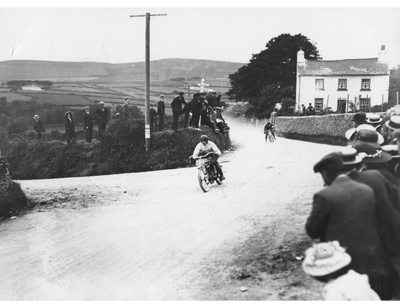
Stanley Woods rode a Cotton to victory in the Junior TT.
On the Mountain Course - where legends are made - the unconventional frame proved its worth.
Through corners where others wavered, the Cotton held its line.
It was no longer a theory.
It was a weapon.
1926 - The Year of Total Dominance
Then came 1926.
The Lightweight TT.
Cotton machines finished:
1st.
2nd.
3rd.
A complete podium sweep.
It wasn’t just victory. It was validation.
The triangulated frame , once questioned , now stood above the field.
In 2026, we mark one hundred years since that defining moment.
A century since Cotton proved that intelligence could outrun convention.
While others chased horsepower, Cotton refined geometry.
The frame connected steering head directly to rear spindle.
Rigidity replaced flex.
Confidence replaced fear.
Riders spoke of “road holding” - the feeling that the machine tracked true through imperfect roads.
Cotton did not build motorcycles to look fast.
They built them to stay fast.
1960S
Decades later, when racing had evolved and the world had changed, Cotton returned.
The Conquest.
The Telstar.
The Starmaker-powered 250cc machines.
In 1964, Derek Minter captured the British 250cc Championship on a Cotton.
In 1965, at Castle Combe, the Conquest achieved class victory in the 500-mile race - proving once again that Cotton still understood speed.
Different era.
Same conviction.
Conquest
By the mid-1960s, racing had changed.
Engines revved higher.
Circuits grew faster.
Manufacturers grew larger.
Cotton remained smaller - but sharper.
And then came the Conquest.
1965 - Castle Combe, 500 Miles
The setting was endurance.
Five hundred miles.
Flat-out.
No margin for weakness.
The Cotton Conquest 250cc, ridden by Derek Minter and Peter Inchley, entered the Castle Combe 500-mile race not as a favourite of scale — but as a machine built with precision.
Powered by the Villiers Starmaker engine, the Conquest combined lightweight agility with race-developed tuning.
What followed was not simply participation.
It was domination of the 250cc class.
The Conquest secured class victory, proving that small capacity did not mean small ambition.
The Telstar - A Sharp-Edged Revival
The Cotton Telstar 250cc was not designed to follow trends.
It was built to win.
Powered by the Villiers Starmaker racing engine, the Telstar was light, aggressive, and unapologetically competition-focused. The Starmaker was one of the most advanced British two-stroke engines of its time — designed specifically for racing, not compromise.
High-revving.
Explosive in the power band.
Minimal excess.
In 1964, Derek Minter rode the Telstar to the British 250cc Championship, proving that Cotton could still compete at the highest level.
It was not nostalgia.
It was resurgence.
The Telstar - A Sharp-Edged Revival
The Villiers Starmaker 247cc was an engine, not a complete motorcycle model.
It was a purpose-built racing engine manufactured by Villiers Engineering, and it was supplied to motorcycle manufacturers - including Cotton - to install in their own chassis.
What Exactly Was the Starmaker?
The Villiers Starmaker was:
- A 247cc single-cylinder two-stroke
- Designed specifically for racing
- Produced in the early 1960s
- One of the most advanced British 250cc racing engines of its time
It was not branded as a “Cotton Starmaker.”
Instead:
- Cotton Telstar, used the Villiers Starmaker engine
- Cotton Conquest, also used the Villiers Starmaker
The Starmaker engine gave Cotton:
- High RPM capability
- Aggressive racing power band
- Competitive 250cc performance
- Championship-winning potential (1964 British 250cc Championship)
It was the heart.
Cotton built the body around it.